 Fairfield County
Sooner or later, every homeowner in Trumbull stands in front of a broken fixture and asks the same question: should I fix this, or should I start over? It sounds simple, but it is one of the most expensive questions in homeownership, because the wrong answer costs you twice. Repair a dying water heater and you pay for the repair plus the replacement a few months later. Replace a toilet that only needed a new flapper and you threw money at a problem that was never really there.
This guide walks through the four decisions Trumbull homeowners face most often: water heater repair vs. replacement, spot pipe repair vs. whole-house repiping, drain clearing vs. sewer line replacement, and toilet repair vs. a new install. For each one, you will get the signs that point to repair, the signs that point to replace, and typical national cost ranges from published cost guides so you can do the comparison with real numbers instead of guesses.
One local note before we start. Trumbull's housing stock spans more than three centuries. A Nichols farmhouse from the 1700s and a Daniels Farm split-level from the 1970s do not fail the same way, and the repair-or-replace math changes with the era of the plumbing. Where the era matters, this guide says so. And one Connecticut note: any plumber doing this work should be licensed through the Connecticut Department of Consumer Protection, and Connecticut's Home Improvement Act requires most jobs beyond simple repairs to be in writing, so get the estimate on paper either way (Connecticut Department of Consumer Protection, n.d.).
The 50 Percent Rule: A Starting Point, Not a Law
Plumbers and home inspectors often cite a rule of thumb: if a repair costs more than half the price of a new unit, and the unit is past the midpoint of its expected life, replacement usually wins. It is a useful starting point because it forces the two numbers that matter onto the same page: what you pay today versus what you pay over the next five years.
But the rule has limits, and knowing them keeps you from misusing it. A $400 repair on a two-year-old water heater fails the 50 percent test against a $900 tank replacement, yet repairing is obviously right, because the unit has a decade of life left. And a $200 repair on a 14-year-old tank passes the test, yet replacing is probably right, because the tank itself is the risk. Age matters as much as price. And for anything that holds water under pressure, the risk of a sudden failure matters most of all, because a burst tank or a split supply line does damage far beyond the cost of the part.
Keep the 50 percent rule in your back pocket as you read the four sections below. Each one applies the same logic to a different fixture, with the specific ages, symptoms, and costs that make the call clear.
Water Heater Repair vs. Replacement
Conventional tank water heaters last about 8 to 12 years in typical residential use, with the U.S. Department of Energy noting that conventional storage models generally serve 10 to 15 years before efficiency and reliability decline (U.S. Department of Energy, n.d.). Tankless units last 20 years or more, which changes the math considerably and is one reason homeowners switch to tankless when an old tank fails. If you do not know your unit's age, check the serial number on the rating plate; most manufacturers encode the manufacture date in the first few characters.
Repair is usually the right call when the unit is under about eight years old, the tank itself is sound, and the problem is a single component. Thermostats, heating elements, thermocouples, pilot assemblies, temperature-and-pressure relief valves, and anode rods are all replaceable parts, and a first-time repair on a younger unit almost always makes sense. Sediment is another common, fixable issue: that rumbling or popping sound from the tank is water boiling through mineral buildup on the bottom, and a professional flush plus a fresh anode rod can quiet it down and extend the tank's life.
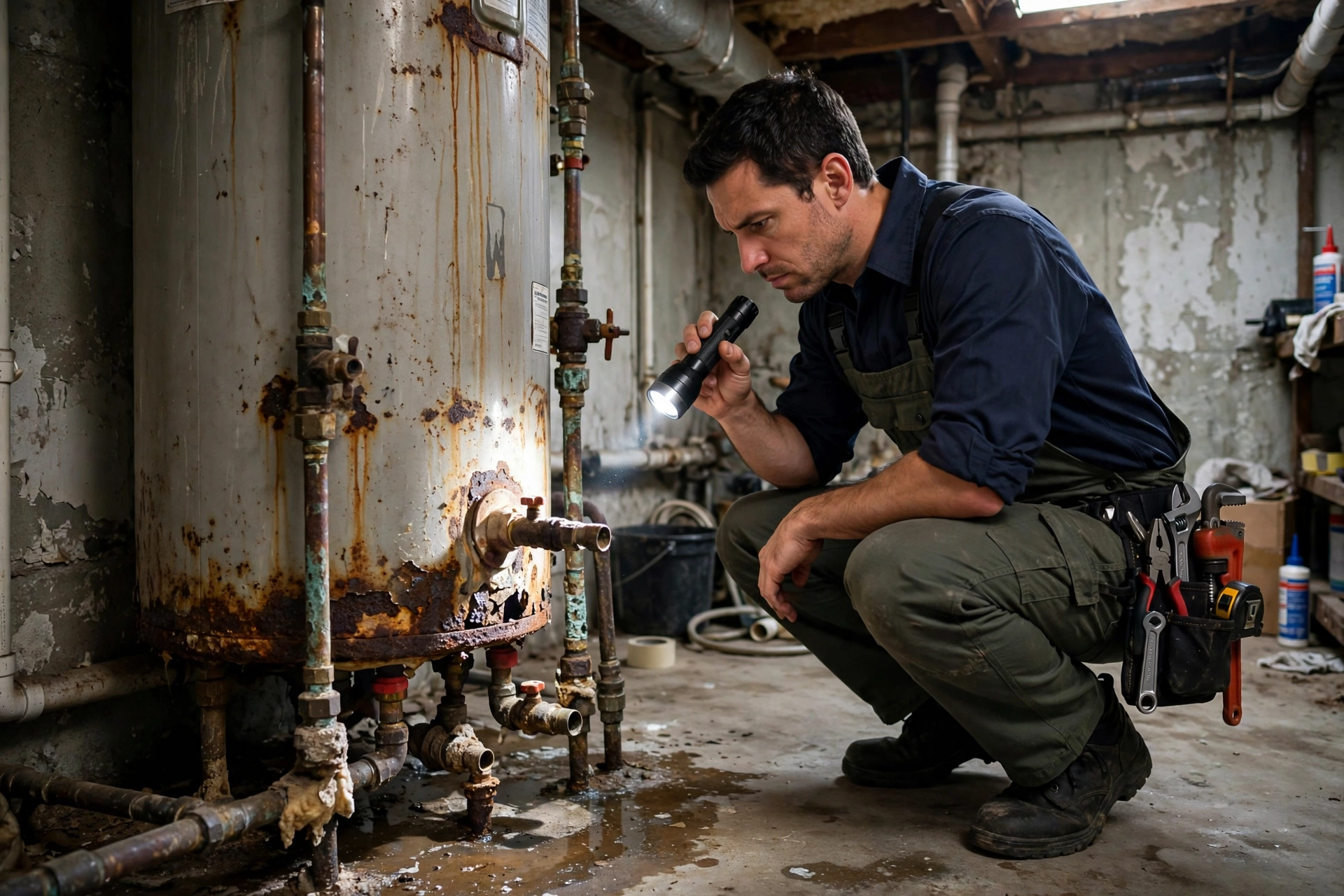
Replacement is the right call when the tank itself is failing. Rust-colored hot water, moisture or weeping around the base, a tank past 10 years that needs a second major repair, or a gas unit whose pilot will not stay lit despite a new thermocouple all point to a tank that has reached the end. A tank does not get better. Once the steel liner is compromised, every additional repair is just renting time, and rented time on a pressurized tank can end with 40 to 50 gallons of water on the floor.
Typical national cost ranges, per published HomeAdvisor cost guides: a minor water heater repair such as a thermostat, element, or thermocouple generally runs $200 to $500; a larger repair such as a gas control valve replacement with a flush runs $300 to $700; a new conventional tank installed runs $900 to $1,800; and a tankless conversion installed runs $2,500 to $4,500 (HomeAdvisor, 2026). Your quote in Trumbull will vary with access, venting, and permit requirements, but these ranges frame the repair-vs-replace comparison honestly.
Real talk: if your tank is 12 years old and rust is weeping from the base, another $300 repair is buying time, not fixing anything.
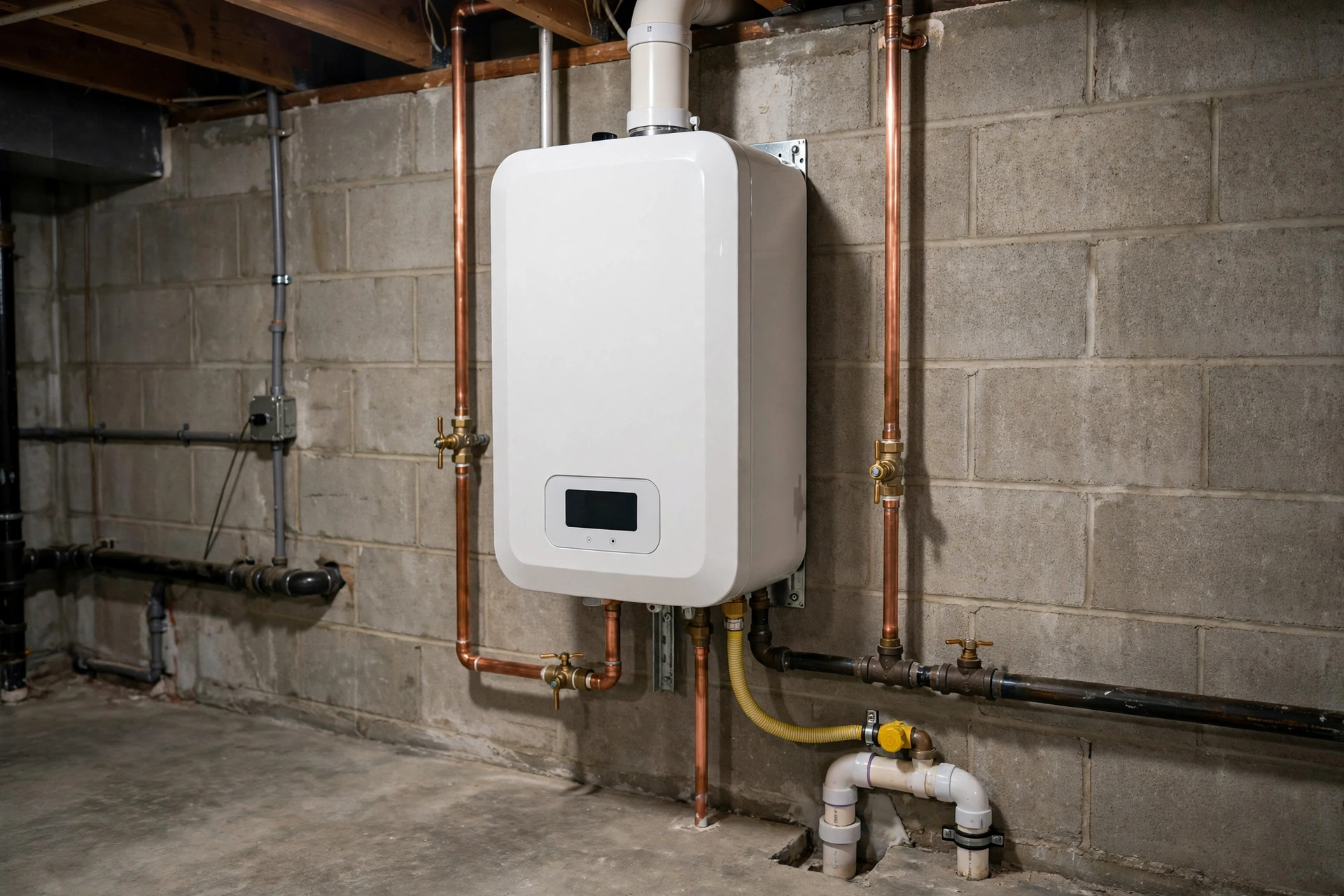
Gas and electric units fail differently, which is worth knowing before you call. Electric heaters usually fail at the elements or thermostats, both straightforward repairs. Gas heaters add the burner, thermocouple, and venting to the equation, and venting problems can be a safety issue, not just a comfort one, so gas repairs deserve a licensed professional every time. If you are weighing a specific unit, the water heater repair page explains what a Trumbull assessment covers.
Spot Pipe Repair vs. Whole-House Repiping
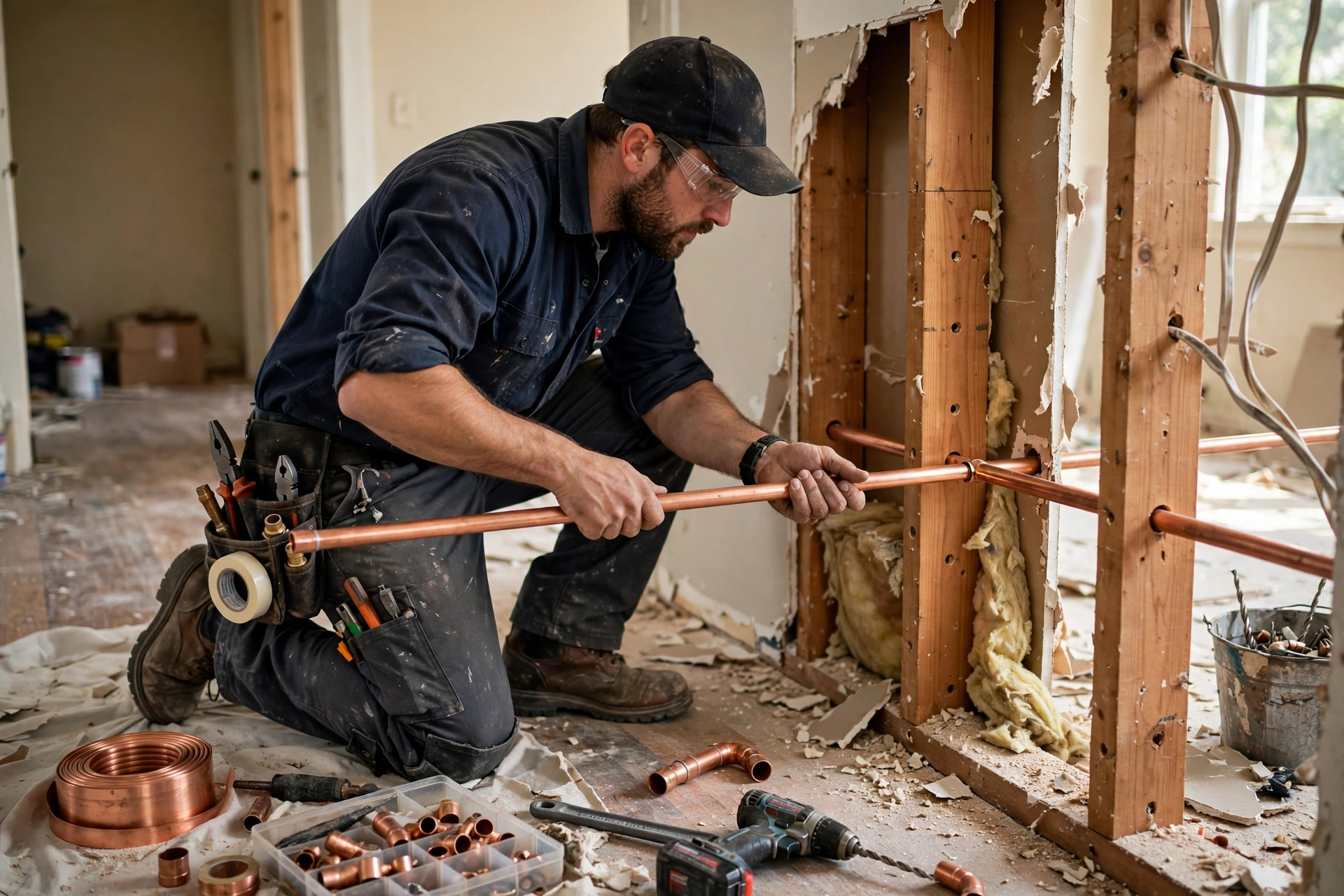
Pipe failures in Trumbull follow the era of the house, which is why the repair-or-replace question for pipes is really a question about your home's age. Nichols and the older sections around Trumbull Center still carry galvanized steel supply lines, which corrode from the inside out over 40 to 60 years until water pressure drops and pinhole leaks appear. Mid-century homes often have copper, which lasts 50 years or more but can develop pinhole leaks from water chemistry and electrolysis. The Daniels Farm-era subdivisions built from the 1960s onward mostly run copper and PVC, which tend to fail at joints and fittings rather than along the pipe itself.
A spot repair, cutting out the failed section and splicing in new pipe, is the right call when the failure is isolated: one pinhole, an accessible location, and the rest of the system still sound. A typical spot repair on an accessible line runs $150 to $400 in national cost-guide ranges, and it can hold for years when the surrounding pipe is healthy. This is the everyday fix for a single burst in a crawlspace after a hard Fairfield County freeze.
Whole-house repiping becomes the smarter call when leaks repeat. Three or more leaks in a year, water pressure dropping at every fixture, rust-colored water that clears after running the tap a while, or galvanized pipe past 50 years all point to a system-wide problem rather than a single bad section. At that point, each spot repair is a patch on a material that is failing everywhere at once, and the labor of opening walls repeatedly starts to rival the cost of doing it once, properly. Data from the U.S. Census Bureau's American Housing Survey on the age of the nation's housing stock helps explain why this decision lands so often in towns like Trumbull, where a large share of homes predate modern plumbing materials (U.S. Census Bureau, 2023).
Repiping a whole house typically runs $4,000 to $15,000 nationally depending on home size, number of bathrooms, and material choice, with PEX at the lower end and copper at the higher end (HomeAdvisor, 2026). Material choice matters for the long term. Copper resists UV and rodents and handles high heat, while PEX installs faster, costs less, and resists freeze-cracking better, which matters in Connecticut winters. This Old House's repiping guides note the same tradeoff and add that PEX's flexibility means fewer fittings and fewer potential leak points behind walls (This Old House, n.d.).
What does a repipe actually involve? Plan on several days of work: the plumber opens walls and ceilings at fixture locations, runs the new lines, and patches or leaves drywall repair for a second trade. Water is typically off during work hours and restored each evening. It is disruptive, but it is one disruption instead of a leak every few months for the next five years. For the full picture of how Trumbull homes are assessed, see pipe repair and repiping.
Drain Clearing vs. Sewer Line Replacement
A slow or backed-up drain tempts a simple answer: clear it and move on. Sometimes that is exactly right. A kitchen line choked with grease or a bathroom line full of hair is a maintenance problem, and a cable clearing typically runs $100 to $350 nationally, with hydro-jetting for heavier buildup at $350 to $600 (HomeAdvisor, 2026). When the clog is soft and the pipe is sound, clearing is all you need.
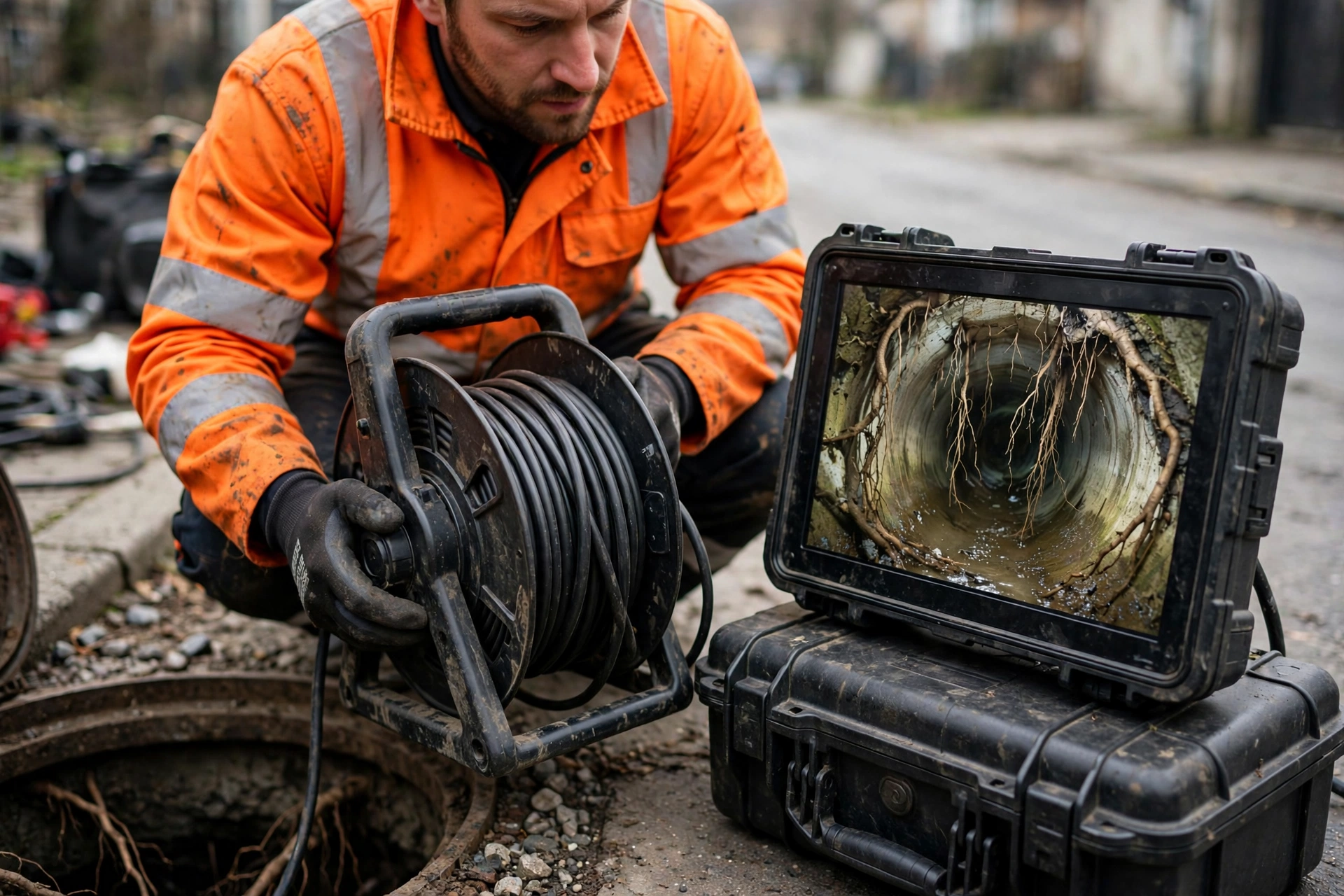
But clearing treats the symptom, and the camera reveals the disease. A drain camera inspection, typically $150 to $400, shows what is actually happening underground: root intrusion at clay tile joints, scale narrowing a cast iron stack, a bellied section that holds water, or an offset joint that snags everything passing through. Trumbull's cast iron drain stacks in pre-1960s homes are prime candidates for scale and joint failure, and mature maples and oaks in older neighborhoods send roots into any joint with the slightest gap. This is the single most useful diagnostic in the repair-or-replace decision, because it turns a guess into a picture.
Replacement enters the picture when the pipe itself is done: a collapsed section, repeated backups within months of a clearing, or camera footage showing major offsets, breaks, or a bellied line that will never drain properly. A spot repair on one bad section runs $1,500 to $4,000; a full sewer lateral replacement by open trench runs $3,000 to $7,000 or more; and trenchless options such as pipe bursting or cured-in-place lining run $6,000 to $12,000 or more, with far less digging (HomeAdvisor, 2026). Trenchless usually costs more per foot, but it spares the driveway, patio, and landscaping, which can make it cheaper overall once restoration is counted. Many towns also require permits and inspections for sewer work, plus an accessible cleanout, so factor that into the timeline.
The practical rule is simple: if a line backs up again within a year of a professional clearing, stop clearing and get the camera in. Two or three clearings a year will pay for a real diagnosis many times over, and every backup risks damage that dwarfs the repair bill. Sewage in a finished basement is not a plumbing expense anymore; it is a restoration project. For camera inspection and replacement options in Trumbull, see sewer line repair and replacement.
Toilet Repair vs. a New Install
Toilets are the simplest repair-or-replace decision in the house, because the parts are cheap and the failure modes are few. A running toilet is usually a worn flapper or a misadjusted fill valve. A weak flush is often a clogged rim jet or a tired flush valve. A leak at the base is a failed wax ring. Common toilet repairs run $125 to $300 nationally, and many are genuinely quick fixes that a homeowner can even handle with a universal repair kit, provided the shutoff valve works.
Replace the whole toilet when the porcelain itself is the problem: a cracked tank or bowl, a hairline crack that weeps, or a toilet that rocks because the flange underneath has rotted. Chronic clogging is another replace signal, especially in pre-1994 toilets designed around 3.5 gallons per flush or more. Those old designs clog because the trapway geometry was never efficient, and no repair changes the geometry of the casting. If you are plunging weekly, you do not have a clog problem; you have a toilet problem.
There is also an efficiency argument that shows up on the water bill. EPA WaterSense-labeled toilets use 1.28 gallons per flush or less, and the EPA estimates that a WaterSense toilet can save about 13,000 gallons of water per year compared with older 3.5-gallon models (U.S. Environmental Protection Agency, n.d.). For a household watching utility costs, a new toilet installed at $220 to $600 nationally, with premium models more, can pay part of its own way over the years.
One caution before you buy the new unit: a toilet that rocks or leaks at the base sometimes hides a rotted subfloor or a broken flange, which turns a simple swap into a bigger job. That is worth knowing before the new toilet is sitting in your hallway, not after. A plumber can pull the old unit, inspect the flange and flooring, and tell you the full scope in a few minutes. The toilet repair and installation page covers what that assessment includes.
A Decision Framework You Can Use Today
When you are standing in front of the problem, run through these five questions before you spend anything:
- How old is it relative to its expected life? Past 75 percent of expected life tilts toward replace. A 10-year-old tank heater and a 50-year-old galvanized line have both told you what they are going to do.
- How often has it needed service? Two repairs in 12 months is a treadmill, not maintenance. Add up what you have already spent; it counts toward the decision.
- What is the repair cost as a share of replacement? Over half, on an aging unit, favors replace. Under a quarter, on a young unit, favors repair. The middle is where the other questions decide.
- What fails if you guess wrong? A failed flapper wastes water; a failed tank floods a basement. Higher stakes justify earlier replacement, because the cost of being wrong is not just the part.
- Is the replacement meaningfully better? A 1.28-gallon toilet or a tankless heater is not just newer; it performs better and costs less to run. When the new version is a genuine upgrade, replacement buys more than reliability.
Real talk: no honest plumber can tell you whether to repair or replace a sewer line without a camera in it first. If someone quotes a replacement sight unseen, get a second opinion.
If you are weighing a specific repair in Trumbull, call (203) 780-0855 and describe what you are seeing. A dispatcher can tell you whether it sounds like a repair visit or a replacement assessment, and the plumber confirms the number in writing before any work starts. Under Connecticut's Home Improvement Act, that written estimate is your right on jobs beyond simple repairs, so ask for it every time.
Frequently Asked Questions
What is the 50 percent rule for plumbing repairs?
If a repair costs more than half of replacement and the fixture is past mid-life, replacement usually wins. It is a guideline, not a law: age, repair history, and the cost of a sudden failure matter just as much as the price ratio.
How long do water heaters actually last?
Conventional tank heaters last about 8 to 12 years in typical residential use, with the U.S. Department of Energy noting 10 to 15 years for storage models. Tankless units last 20 years or more. Hard water, high temperature settings, and skipped anode-rod checks shorten tank life.
Will homeowners insurance pay for repiping?
Usually not for wear and tear. Homeowners insurance typically covers sudden, accidental water damage, not the cost of replacing old pipes. Policies vary, so check yours before assuming either way.
Is trenchless sewer repair always cheaper than digging?
Not per foot; trenchless often costs more per foot than open-trench work. It can still cost less overall because there is no driveway, patio, or landscaping to restore. Get both options quoted with restoration included before deciding.
My toilet runs constantly. Repair or replace?
Almost always repair first. A running toilet is usually a worn flapper or fill valve, both inexpensive fixes. Replace only if the porcelain is cracked, the flange underneath is rotted, or it is a pre-1994 water guzzler that clogs constantly.
Should I replace galvanized pipes before they leak?
If your home still has galvanized supply lines past 50 years, proactive replacement is worth serious consideration. Galvanized pipe fails from the inside out, so the first visible leak is rarely the first weak spot. A plumber can check pressure and water quality for warning signs.
References
- Connecticut Department of Consumer Protection. (n.d.). Occupational and professional licensing. https://portal.ct.gov/dcp
- HomeAdvisor. (2026). How much does it cost to install a water heater? https://www.homeadvisor.com/cost/plumbing/install-a-water-heater/
- HomeAdvisor. (2026). How much does it cost to repipe a house? https://www.homeadvisor.com/cost/plumbing/repipe-a-house/
- HomeAdvisor. (2026). How much does sewer line replacement cost? https://www.homeadvisor.com/cost/plumbing/install-or-replace-sewer/
- This Old House. (n.d.). Plumbing guides: Repiping and pipe repair. https://www.thisoldhouse.com/plumbing
- U.S. Census Bureau. (2023). American Housing Survey. https://www.census.gov/programs-surveys/ahs.html
- U.S. Department of Energy. (n.d.). Energy-efficient water heating. https://www.energy.gov/energysaver/water-heating
- U.S. Environmental Protection Agency. (n.d.). Residential toilets. https://www.epa.gov/watersense/residential-toilets
Not Sure Whether to Repair or Replace?
Describe what you are seeing and get an honest assessment, with the price in writing before any work starts.
Call (203) 780-0855